
June 2025
Growing For The Future (G4TF) project in fruit trees, Certis Belchim’s commitment to sustainable agriculture.
Elías Mas (Project Manager) Certis Belchim España. elias.mas@certisbelchim.com
Laurence Gutierrez (Marketing Manager) Certis Belchim España. laurence.gutierrez@certisbelchim.com
At Certis Belchim, we believe in innovative initiatives that revolutionize agriculture through nature-based solutions and advanced technology that reinforces traditional methods. In the face of current agricultural challenges, with a clear reduction in conventional active ingredients available for European agriculture, we focus on combining biological control methods with the use of conventional plant protection products. This integrated production strategy allows us to minimize the use of conventional products without negatively impacting pest and disease control, while also reducing our environmental impact. Consumer demand for increasingly safer food underscores the transition toward integrated production agriculture, in line with our mission for a sustainable future.
Growing for the Future is Certis Belchim’s strategic project, through which we commit to our producers, sustainability, and food safety aiming for the best productions for the consumers.
This strategic project has been implemented in fruit orchards to measure five key indicators:
- Achieve effective pest and disease control.
- Reduce the number of conventional plant protection products applied.
- Ensure a residue-free harvest.
- Minimize the Environmental Impact Quotient (EIQ).
- Ensure profitability for farmers (high yield).
To achieve these indicators, we use integrated methods and resources such as integrated pest management, pollinator protection, integration of auxiliary fauna, promotion of plant cover, integration of new technologies, irrigation optimization, and careful soil use, all with the aim of advancing regenerative agriculture.
The project compares the Certis Belchim (CB) program with a conventional program, which in this case was carried out on three-year-old nectarine crops (Gea variety) with a planting frame of 5.75 x 2.75 m in the town of Guareña (Badajoz) in 2024.
Both programs carried out applications during the campaign to control San José scale, thrips, aphids, anarsia and grapholita, fruit flies, bacteriosis, powdery mildew, monilia, and leaf curl, also accounting for crop production and yield. The G4TF program by Certis Belchim used several conventional products in conjunction with a variety of biorational solutions and biostimulants. On the other hand, the standard conventional program was based on various active ingredients traditionally used by local farmers to control local pests and diseases.
Both programs achieved good pest and disease control. In addition, diseases that can cause postharvest problems, such as Monilia, Penicillium, Rhizopus, and Geotrichum, were also perfectly controlled. In this regard, after harvest, the fruit was kept at a controlled temperature between 18°C and 24°C and a relative humidity (RH) close to 100% in storage chambers from harvest (June 24, 2024) until the shipping date (July 11, 2024) for 18 days, without breaking the controlled temperatures until export. The production was shipped by sea to its destination in Brazil, without breaking the controlled temperatures until arrival at the port of Basil on August 1, 2024, 21 days after shipment. The merchandise was analysed at the destination for quality control, and it was verified that the conservation was excellent. All merchandise met the quality and marketing standards for both G4TF program fruit and the conventional standard program.
Other key project indicators include a 50% reduction in the use of chemical or conventional plant protection products (PPP) in the G4TF Program by Certis Belchim which used seven treatments of conventional PPP compared to 14 treatments in the conventional standard program.
In addition, Certis Belchim’s G4TF program recorded no residues in the fruit at harvest, while the conventional program detected four active substances. Following residue analysis at harvest, residue levels consistently remained below EU MRLs.
The G4TF program had a much lower environmental impact than the conventional program. Figure 1 shows a 79.3% reduction in the environmental impact of the G4TF program compared to the standard conventional program.
Chart 1. Environmental Impact Quotient (EIQ)*

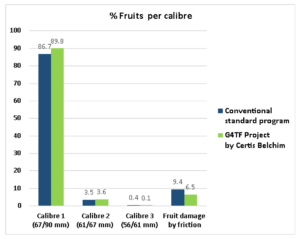
Regarding key factors such as size and production, it is worth noting that both parameters were improved in the Certis Belchim program. Output was significant with an increment of 14.5% for production in the G4TF program vs the conventional standard program. With regards to the fruit size, the results showed that in the Growing for the future project, 90% of the harvest was classified as caliber 1 (67/90 mm).
Chart 2: Production in Kg/ha of both programs

Chart 3: % Fruits of each calibre depending on the size of the fruit (diameter).
An economic study considering production, the price of fruit by size at the time of the study, and production costs based on the products used in each program, concludes that the Certis Belchim program slightly improves profits, as detailed in Table 1.
Economically, the Certis Belchim G4TF project obtained a net profit 5.2% higher than that of the conventional standard program.
Table 1. Profit obtained based on the costs of the products used

Conclusions
- Both programs have shown very good efficacy against the pests and diseases encountered.
- The Certis Belchim program has reduced the number of treatments with conventional phytosanitary products by 50%.
- The Certis Belchim program has achieved residue-free fruit production.
- The environmental impact quotient (EIQ) is much lower in the G4TF program, showing a 79.3% reduction compared to the standard conventional program.
- Production and profitability have been higher with the G4TF program (production +14.5% and profitability +5.2%) compared to the conventional standard program.
Our commitment to delivering innovative crop protection solutions to enable sustainable agriculture is assisting and supporting farmers in an ever-growing range of crops.
Acknowledgments:
This project will last a total of three years, and all indicators will be evaluated annually to corroborate the results. Certis Belchim would like to thank Tany Nature for providing the plots where this study was conducted. We also thank its technical team for their collaboration and willingness to carry out this work, as well as their technical advice in carrying out all treatments at the appropriate times, based on their knowledge of the plots, and their collaboration in monitoring them during this first campaign.
Products used in crop protection programs for the trial
G4TF by Certis Belchim: Biorational products and biostimulants are combined in a program with the use of conventional active ingredients:
Mospilan® Max (Acetamiprid 20% SC) was used against aphids;
Expedient (Piriproxifen 10% EC) was used to control “San Jose scale”;
Coragen (Chlorantraniliprol 20 SC), Turex® (Bacillus thuringiensis sp. aizawai 50% WG) and Delfin® (Bacillus thuringiensis sp. kurstaki 11.85% WG) for anarsia and grapholita;
Botanigard® (Beauveria bassiana strain GHA 10.7% OD) and Neudosan (Potassium soap 51.5% SL), both products under development, against thrips;
Breaker Max® (Natural pyrethrin 4% EC) against fruit flies (aphids with fruit fly effect recorded);
Kdos® (Cupric hydroxide 35% WG) against leaf spot, leaf curl, and bacteriosis;
Amylo-X® (Bacillus amyloliquefaciens strain D-747 25% WG) and Armicarb® (Potassium hydrogen carbonate 85% SP) for monilia control;
Cyflamid® (Cyflufenamide 5.1% EW) and Mavita (Difenoconazole 25% EC) against powdery mildew;
Biostimulants from Certis Belchim of which we highlight Pushy+®, Hyt-A® Biosmart®, C-Bio® Grow, Moka® and Proactive® K.
Standard conventional program
Various active ingredients traditionally used by local farmers to control local pests and diseases, included the following: pyriproxyfen, flonicamid, chlorantraniliprole, deltamethrin, acetamiprid, spinosad, copper hydroxide, carboxamide, dodine, tebuconazole, sulfur, difenoconazole, formetanate, fluopyram + tebuconazole, tebuconazole + trifloxytrobin, and amino acid- and brown algae-based biostimulants as part of their nutritional program.